AI in a real business, from a product leader's side of the table
When the work gets cheap, a business is worth its judgement.
I'm optimistic about AI. It will make most businesses more capable than they have ever been. The ones that come out ahead will keep three things while the work changes: people who know what good looks like, a written record of it, and a way of producing more people who know.
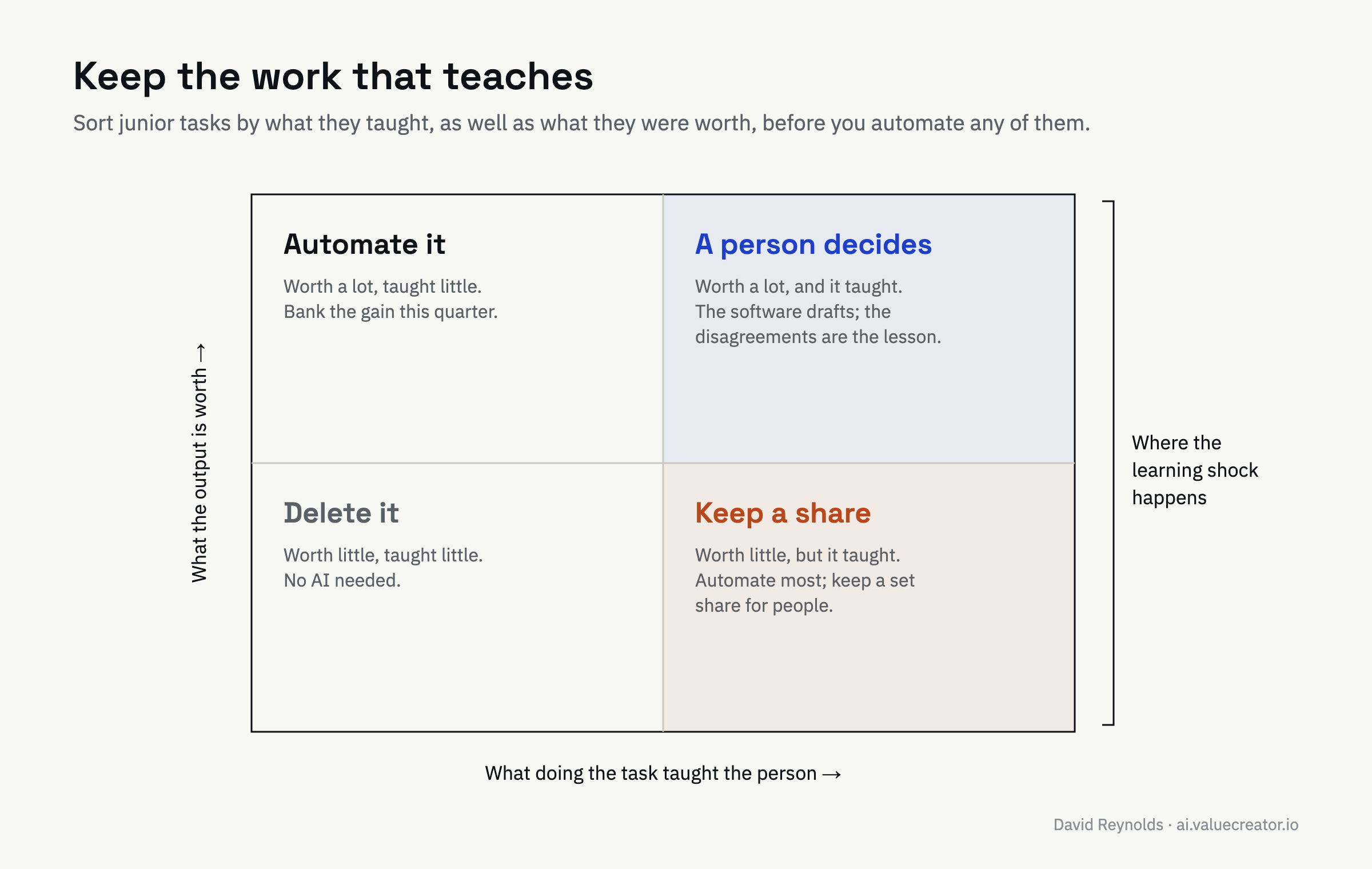
Start with the question you have
01
Where do I start?
Before choosing any tools, find the work where AI will actually show up.
- Where the time actually goes5 min
How I decide where to point AI: the job, five minutes either side, one workflow at a time.
02
What does it mean for the business?
What changes when doing the work gets cheap, and what to plan for.
- The bottom was the training programme12 min
What AI does to how people learn, and the year I could be proved wrong.
03
How do I put it to work?
What to rent, what to own, and how software earns the right to act on its own.
- Earned autonomy16 min
AI can give you an answer, but it can't own one. How an agent earns more freedom, and loses it.
04
How do I know it's working?
Keep what AI is said to save apart from what actually reaches the accounts.
- If the AI becomes the business, what is the business?12 min
What to delete first, claimed against banked, and why quality you can prove is worth more than time you save.
05
What could we sell because of it?
AI makes the work cheaper. The judgement around it is what you can sell. This is the side with room to try things, and how you charge decides who keeps the saving.
- Pay for the outcome6 min
Most AI plans are cost plans. Where the revenue is, and why how you charge decides who keeps the saving.
The playbook is open
How I run it is also on GitHub. Every tool is a markdown file you can copy and change, with a thirty-point self-check for the person building it and a Claude plugin that runs ten of the exercises with you. The plugin has its own test set and register, as the playbook says any AI tool should. It's free to use under CC BY 4.0.
If you're technical and want to help, try a tool on real work and tell me what you changed. The next edition will be better for it.
In Claude Code: claude plugin marketplace add reynolds-uk/ai-playbook, then claude plugin install ai-playbook@ai-playbook
Three questions I'd put to any leadership team
- 01Which of your work is the bottom of the pyramid, what does it cost, and what did it teach?
- 02Who decides what good looks like once the machines are doing the work, and is it written down?
- 03Where will your next generation of experienced people come from?
Where this comes from
This is my view of AI and the future of work, from the side of the people who have to run it. It comes from twenty years of applying new technology inside real businesses, building some of it myself, and keeping what held up. In a note in 2025 I said the future of work was about outcomes rather than jobs. What's changed since is that the work itself is getting cheap, and that shifts what a business depends on towards its judgement.
Every big wave of technology I know of has ended up creating more work than it removed, though rarely for the same people or on the same timescale. What each wave also changed was how people learned their trade. That's the part I think is worth planning for this time, and it's the part that's easiest to miss.
I think about AI the way a product person does: start with the job, decide what to build, what to buy and what only you can own, and measure what reaches the accounts.