The pictures

Seven pictures from the pieces on this site. Each is shown with the paragraph it belongs to, because each picture makes most sense next to the text it came from. Download them as SVG or PNG and use them freely, with a credit to David Reynolds · ai.valuecreator.io.

The invisible damage

From When the work gets cheap

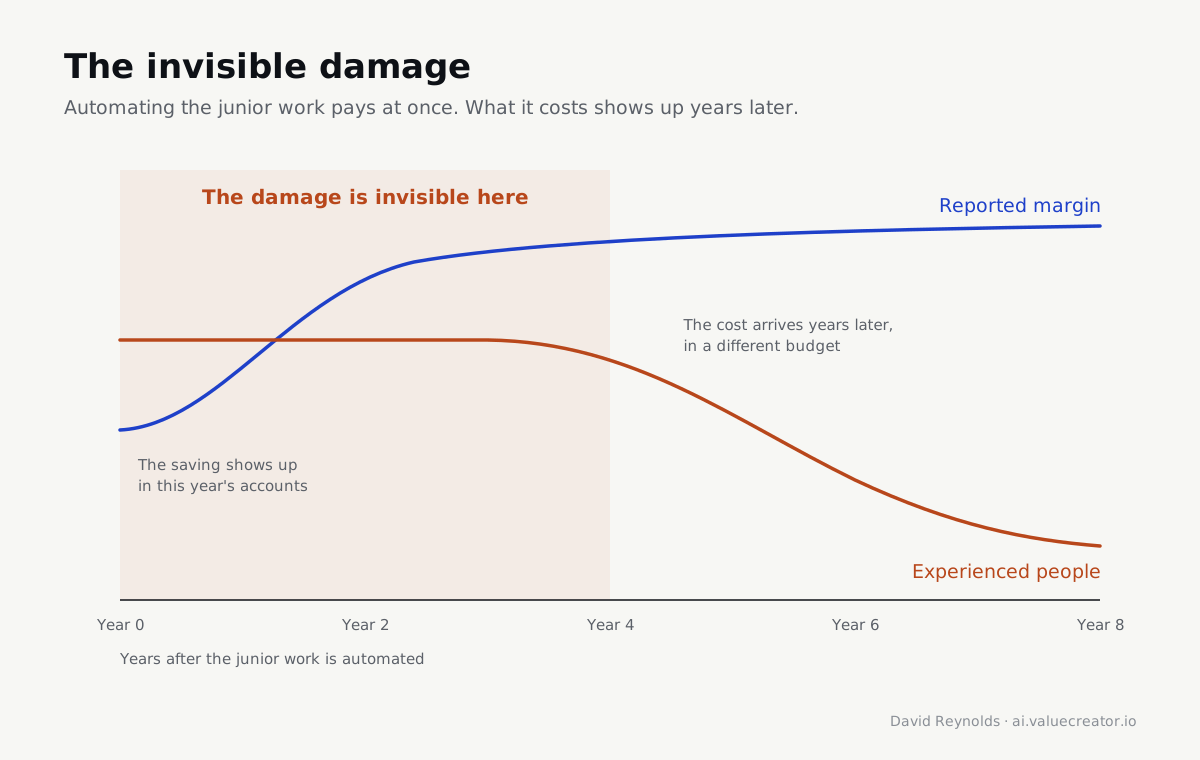
The saving from automating junior work shows up this year. The cost shows up in five, as a missing layer of experienced people, in a different budget and often under a different chief executive. No single report shows both, which is why it's easy to miss. It is avoidable: decide which work people keep because it teaches, and the line doesn't have to bend.

The invisible damageAutomating the junior work pays at once. What it costs shows up years later.Year 0Year 2Year 4Year 6Year 8Years after the junior work is automatedReported marginExperienced peopleThe damage is invisible hereThe saving shows upin this year's accountsThe cost arrives years later,in a different budgetDavid Reynolds · ai.valuecreator.io
Year 0Year 4Year 8Years after the junior work is automatedReported marginExperiencedpeopleThe damage isinvisible hereThe saving shows up in this year's accounts.The cost arrives years later,in a different budget.

Download SVGDownload PNGLink to this picture

Keep the work that teaches

From The bottom was the training programme

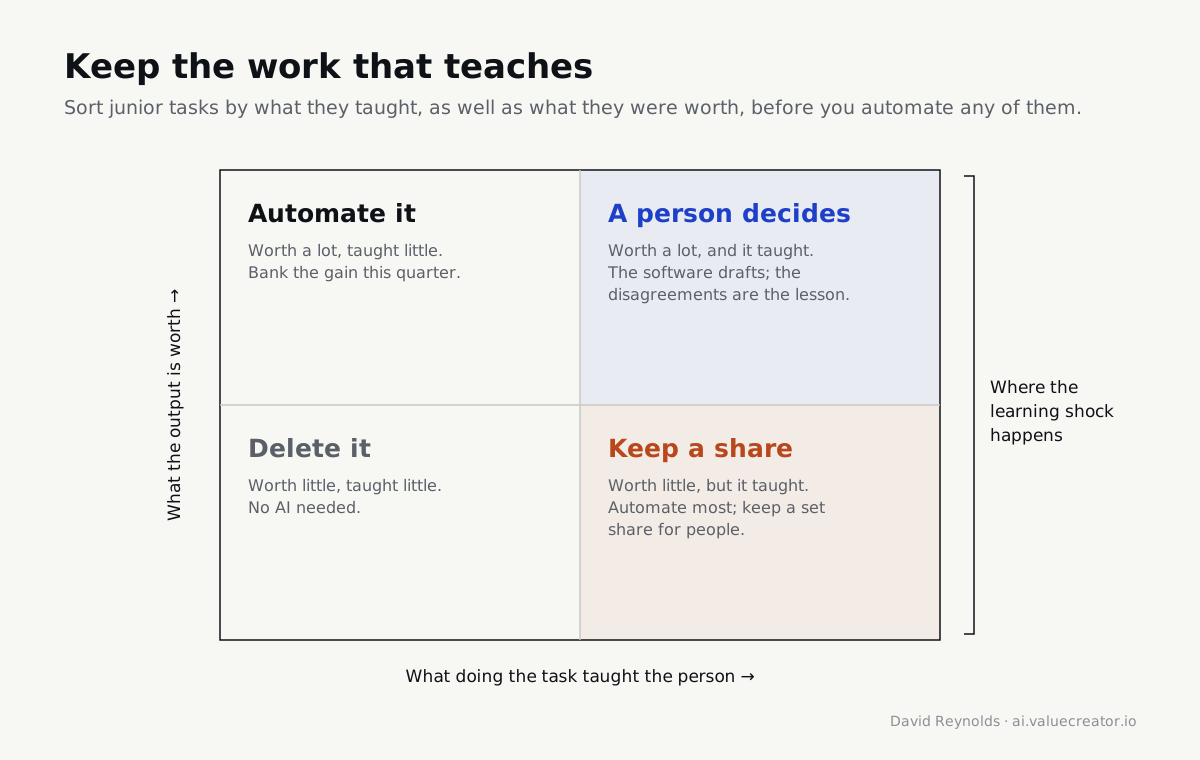
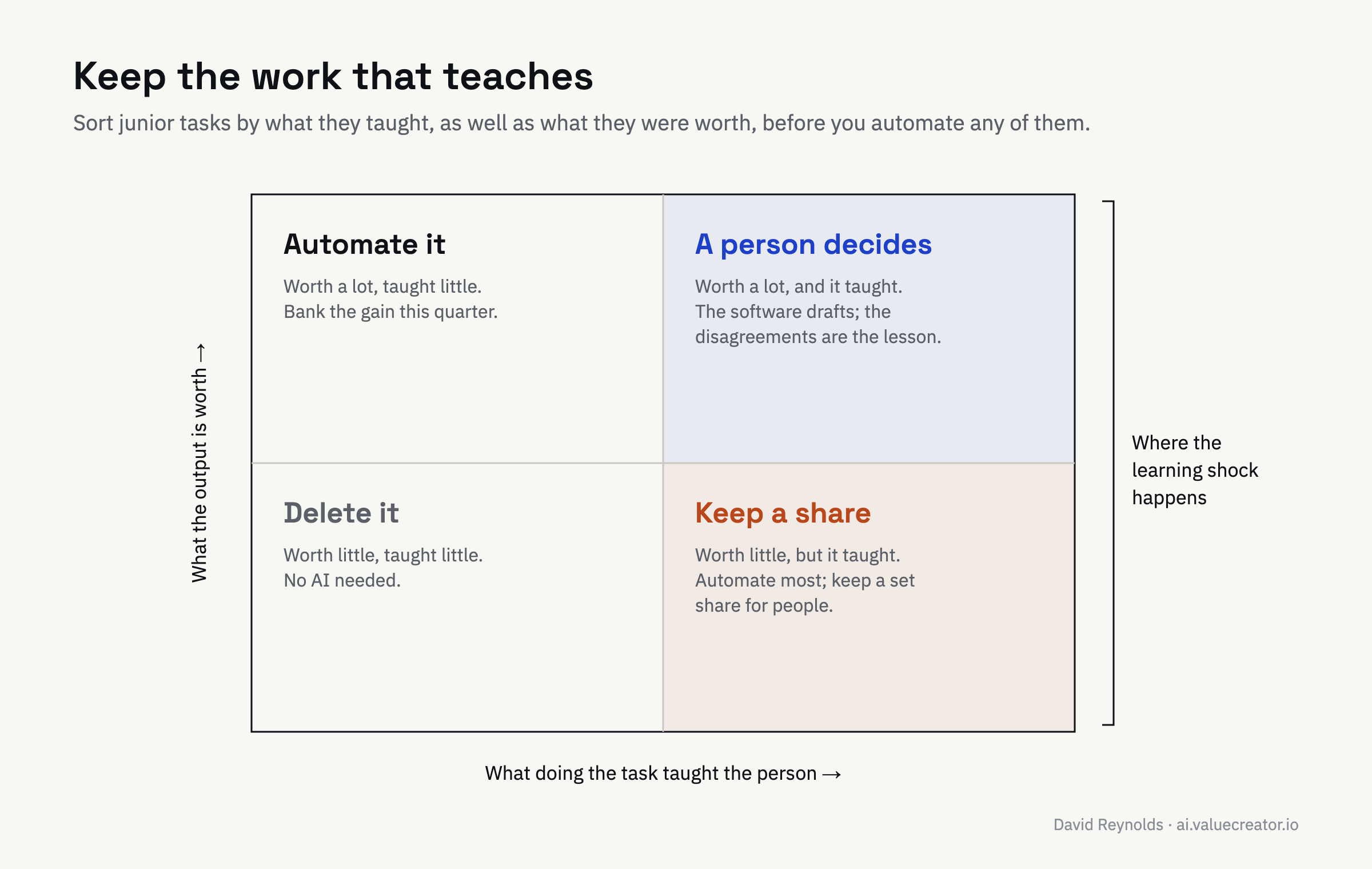
Most automation decisions sort tasks by what the output is worth. Sort them by what doing the task taught as well, and every junior task lands in one of four places. Automate what taught nothing. Where the task was how people learned, let the software draft and keep a person deciding, or keep a share of the volume for people. The right-hand column is where the learning shock happens.

Keep the work that teachesSort junior tasks by what they taught, as well as what they were worth, before you automate any of them.Automate itWorth a lot, taught little.Bank the gain this quarter.A person decidesWorth a lot, and it taught.The software drafts; thedisagreements are the lesson.Delete itWorth little, taught little.No AI needed.Keep a shareWorth little, but it taught.Automate most; keep a setshare for people.What doing the task taught the person →What the output is worth →Where thelearning shockhappensDavid Reynolds · ai.valuecreator.io
Automate itWorth a lot,taught little.Bank the gainthis quarter.A persondecidesWorth a lot, andit taught. Thesoftware drafts;disagreementsare the lesson.Delete itWorth little,taught little.No AI needed.Keep a shareWorth little, butit taught. Keep aset share of itfor people.What doing the task taught →What the output is worth →The right-hand column is wherethe learning shock happens.

Download SVGDownload PNGLink to this picture

Better agents make worse supervisors

From The bottom was the training programme

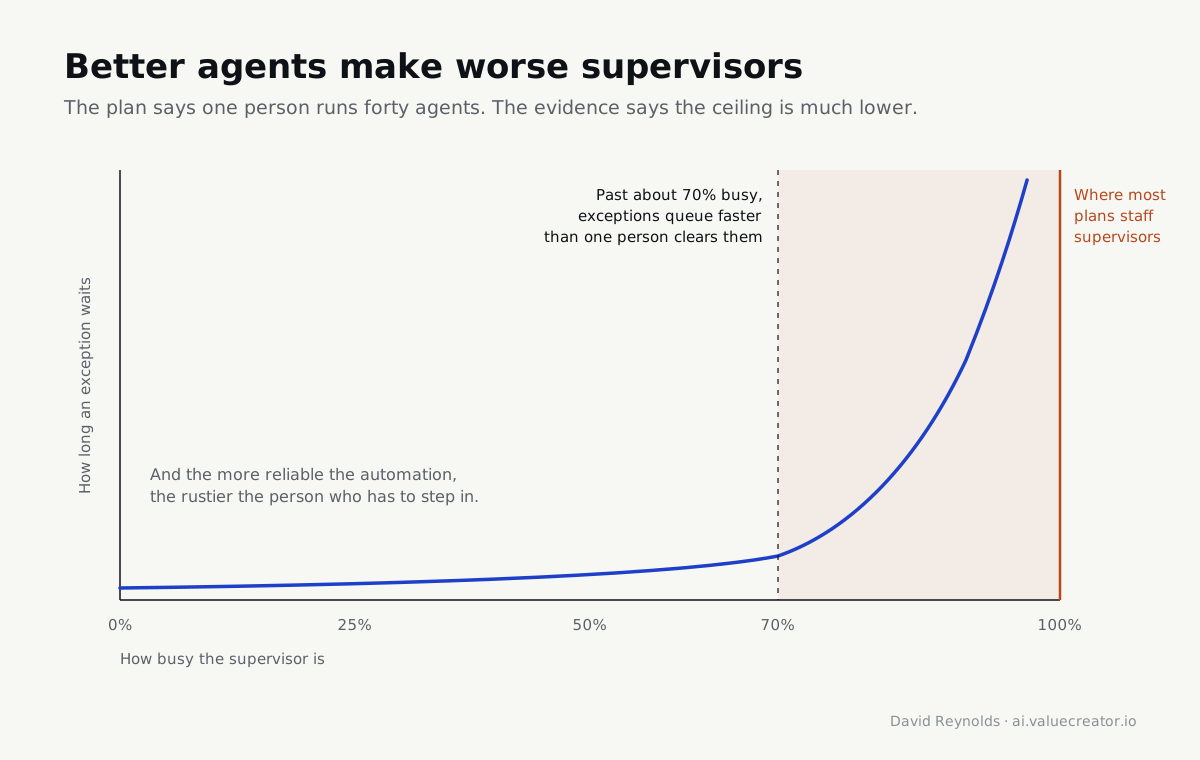
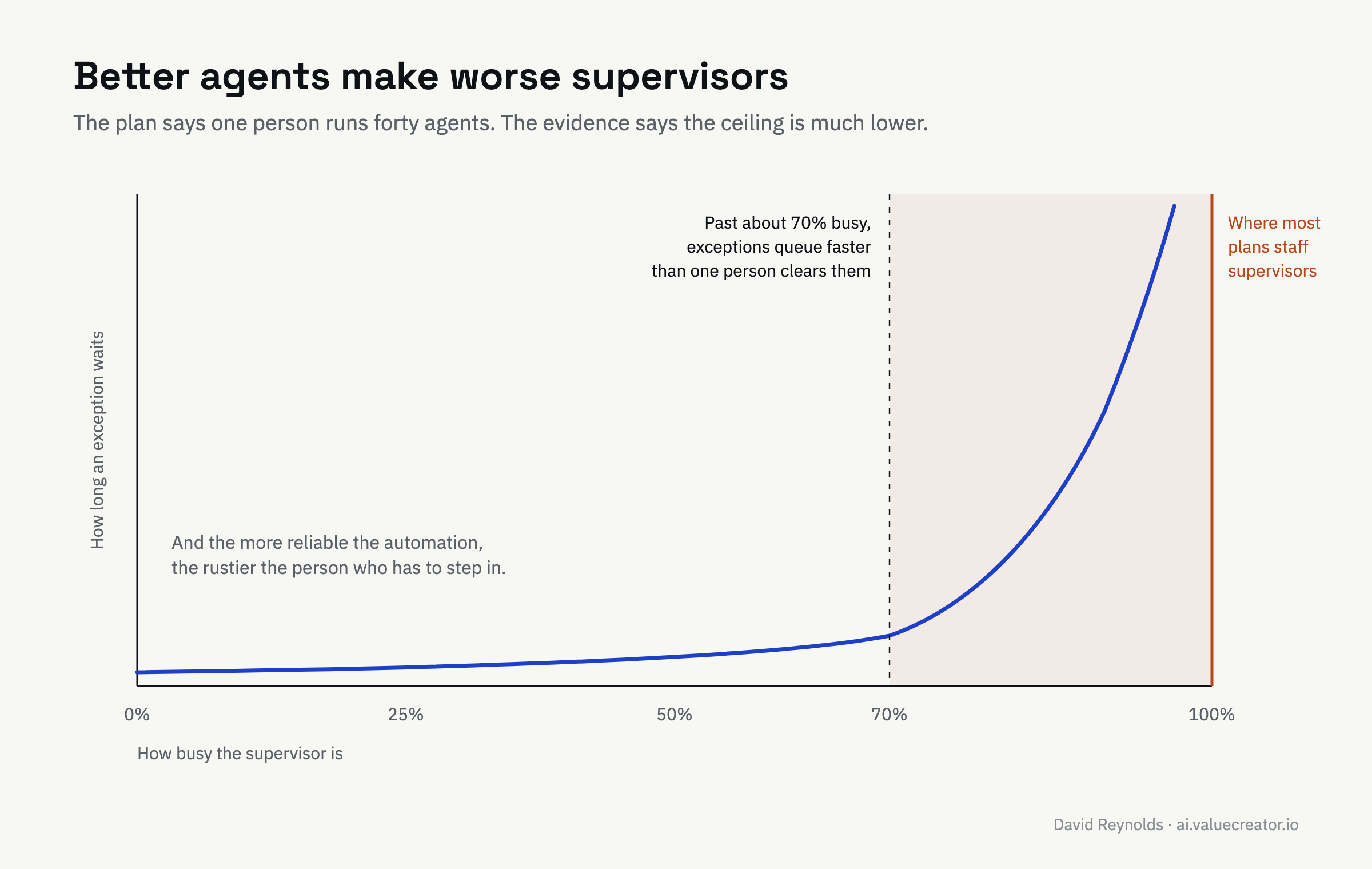
Once a person is past about seventy per cent busy, the exceptions waiting for them pile up faster than they can clear them, and most plans staff supervisors towards a hundred. The more reliable the automation, the worse people get at stepping in when it fails. Most plans assume one person can run far more agents than they can.

Better agents make worse supervisorsThe plan says one person runs forty agents. The evidence says the ceiling is much lower.0%25%50%70%100%How busy the supervisor isHow long an exception waitsPast about 70% busy,exceptions queue fasterthan one person clears themWhere mostplans staffsupervisorsAnd the more reliable the automation,the rustier the person who has to step in.David Reynolds · ai.valuecreator.io
0%50%70%100%How busy the supervisor isHow long an exception waitsPast about 70% busy, exceptions queuefaster than one person clears them.Most plans staff supervisors near 100%.And the more reliable the automation,the rustier the person who steps in.

Download SVGDownload PNGLink to this picture

Earned, not assumed

From Earned autonomy

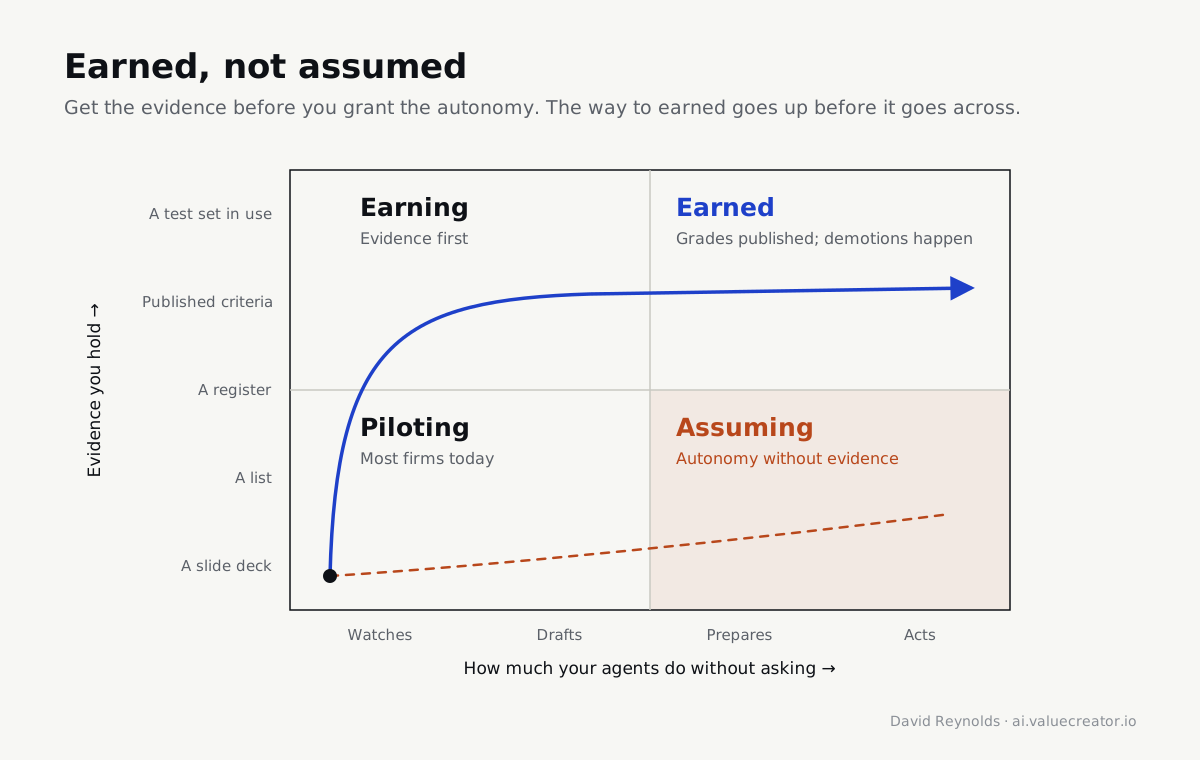
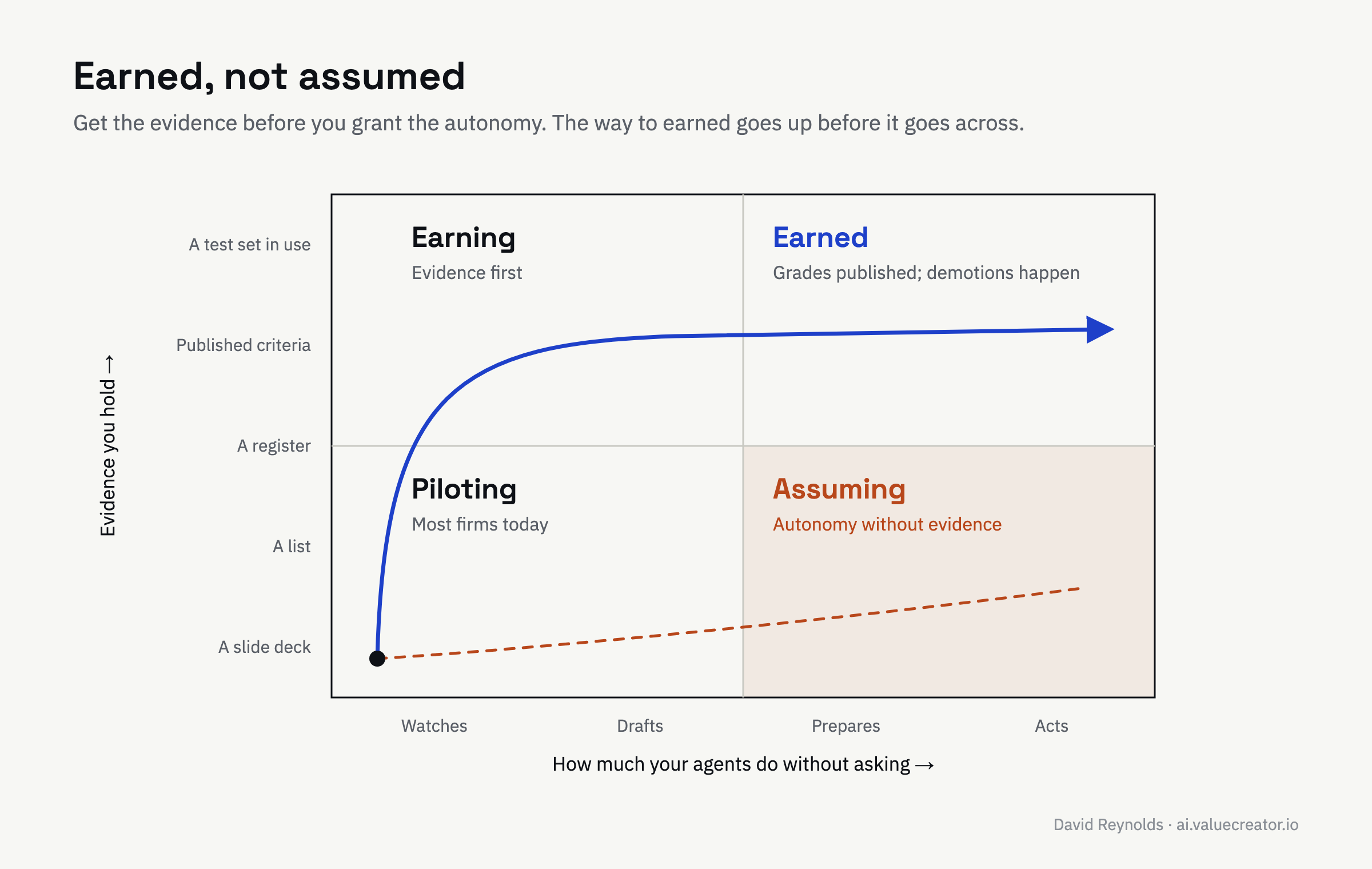
Along the bottom, how much your agents do without asking. Up the side, how much evidence you hold that they should. Most businesses are piloting, which is a fine place to start. The dangerous businesses are the ones that have granted autonomy without the evidence behind it. To reach "earned", move up before you move across: get the evidence, then grant the autonomy.

Earned, not assumedGet the evidence before you grant the autonomy. The way to earned goes up before it goes across.EarningEvidence firstEarnedGrades published; demotions happenPilotingMost firms todayAssumingAutonomy without evidenceWatchesDraftsPreparesActsHow much your agents do without asking →A test set in usePublished criteriaA registerA listA slide deckEvidence you hold →David Reynolds · ai.valuecreator.io
EarningEvidence firstEarnedGrades publishedPilotingMost firmsAssumingNo evidenceWatchesDraftsPreparesActsWhat agents do without asking →A test setCriteriaA registerA listA slide deckEvidence you hold →Get the evidence first. The way to earnedgoes up before it goes across.

Download SVGDownload PNGLink to this picture

The layer you own

From The layer you own

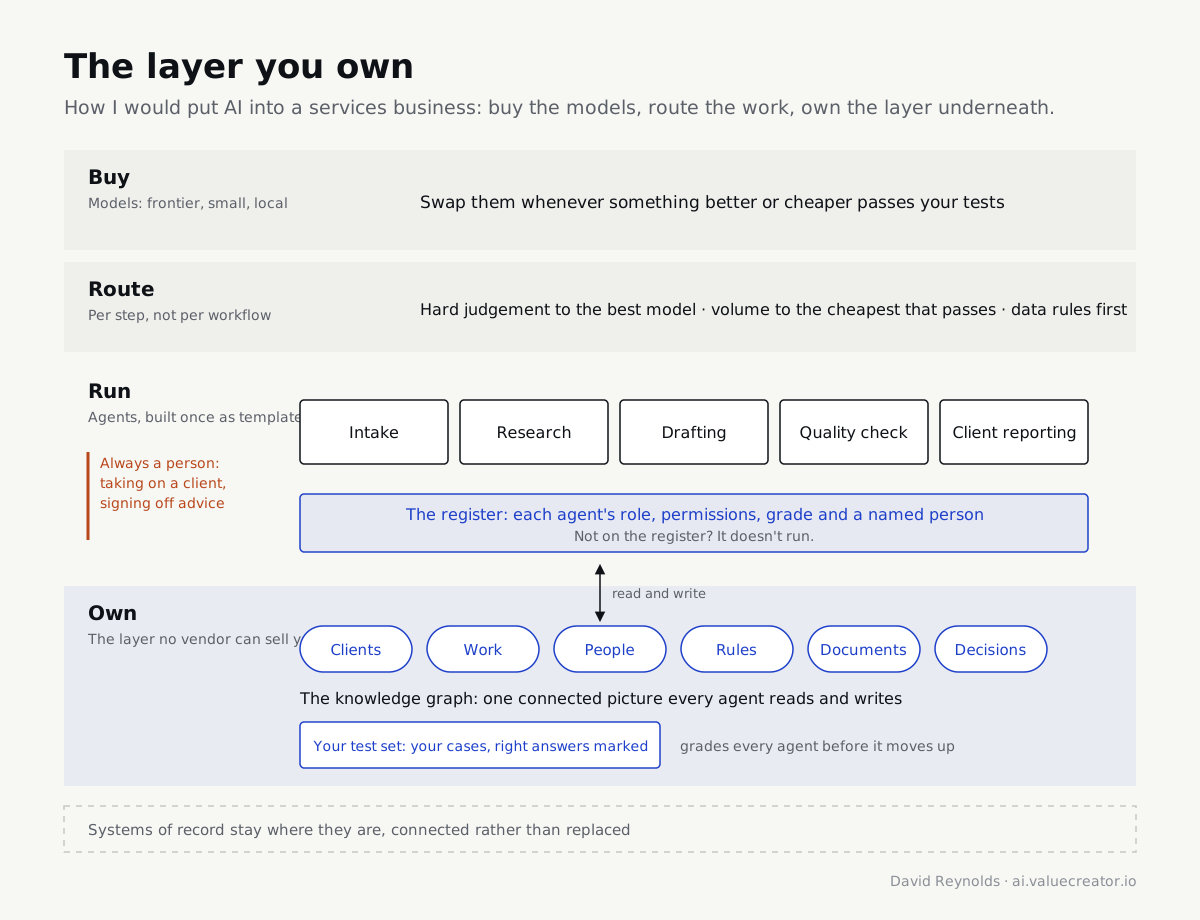
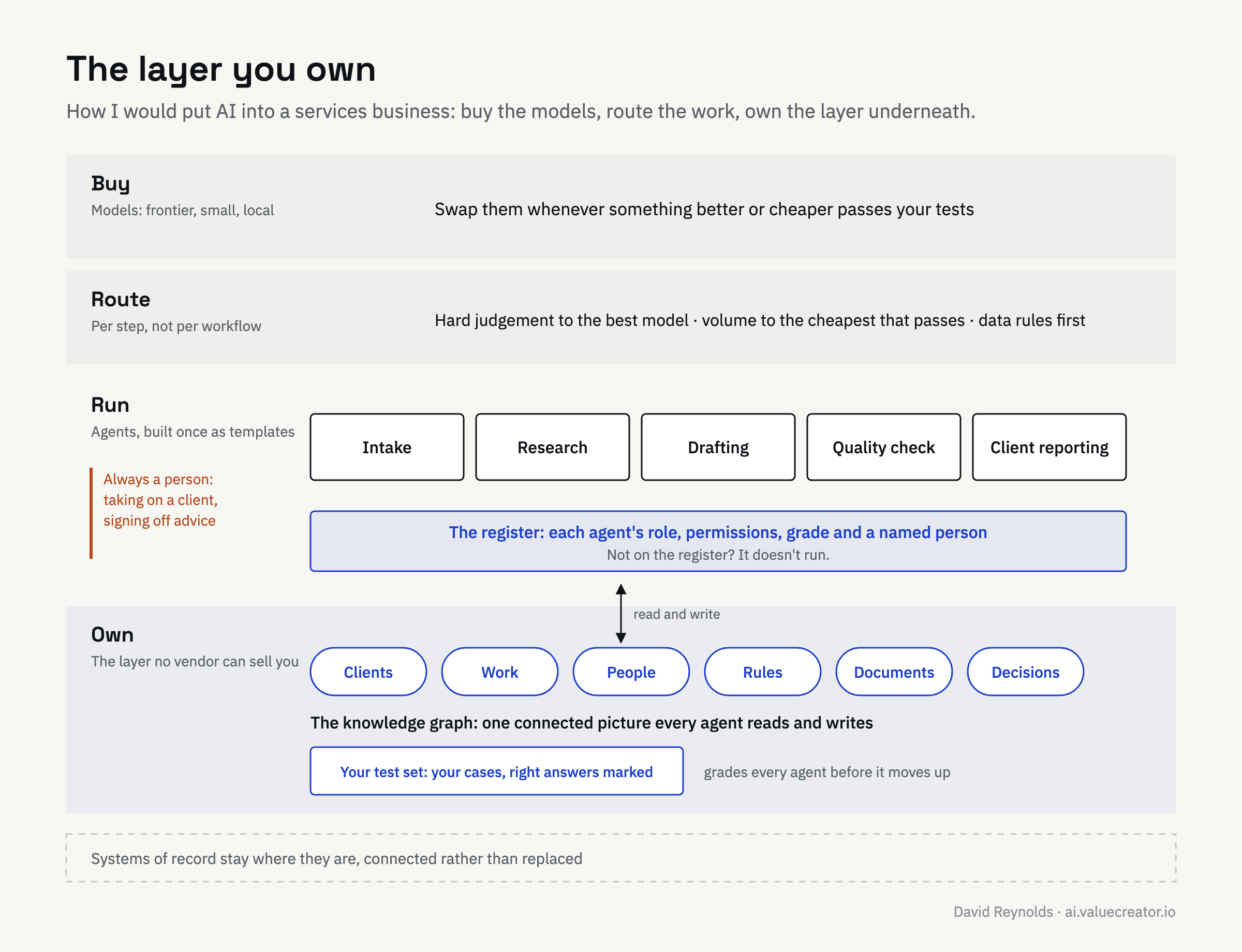
Buy the models and swap them when something better passes your tests. Route each step to the cheapest model that passes. Own the layer underneath: one connected picture of your clients, your work and your decisions, a register of every agent with a named person against it, and a test set made from your own cases. The decision a client relies on stays with a person.

The layer you ownHow I would put AI into a services business: buy the models, route the work, own the layer underneath.BuyModels: frontier, small, localSwap them whenever something better or cheaper passes your testsRoutePer step, not per workflowHard judgement to the best model · volume to the cheapest that passes · data rules firstRunAgents, built once as templatesIntakeResearchDraftingQuality checkClient reportingThe register: each agent's role, permissions, grade and a named personNot on the register? It doesn't run.OwnThe layer no vendor can sell youClientsWorkPeopleRulesDocumentsDecisionsThe knowledge graph: one connected picture every agent reads and writesYour test set: your cases, right answers markedgrades every agent before it moves upread and writeSystems of record stay where they are, connected rather than replacedAlways a person:taking on a client,signing off adviceDavid Reynolds · ai.valuecreator.io
BuyModels: frontier, small, localSwap them when a better one passes your tests.RoutePer step, not per workflowHard judgement to the best model; volume to the cheapest.RunAgents, built once as templatesIntakeResearchDraftingQuality checkClient reportingThe register: role, permissions,grade and a named personAlways a person: taking on a client,signing off advice.OwnThe layer no vendor can sell youClientsWorkPeopleRulesDocumentsDecisionsThe knowledge graph: one connected pictureevery agent reads and writes.Your test set: your cases, answers markedSystems of record stay where they are,connected rather than replaced.

Download SVGDownload PNGLink to this picture

Where the time actually goes

From Where the time actually goes

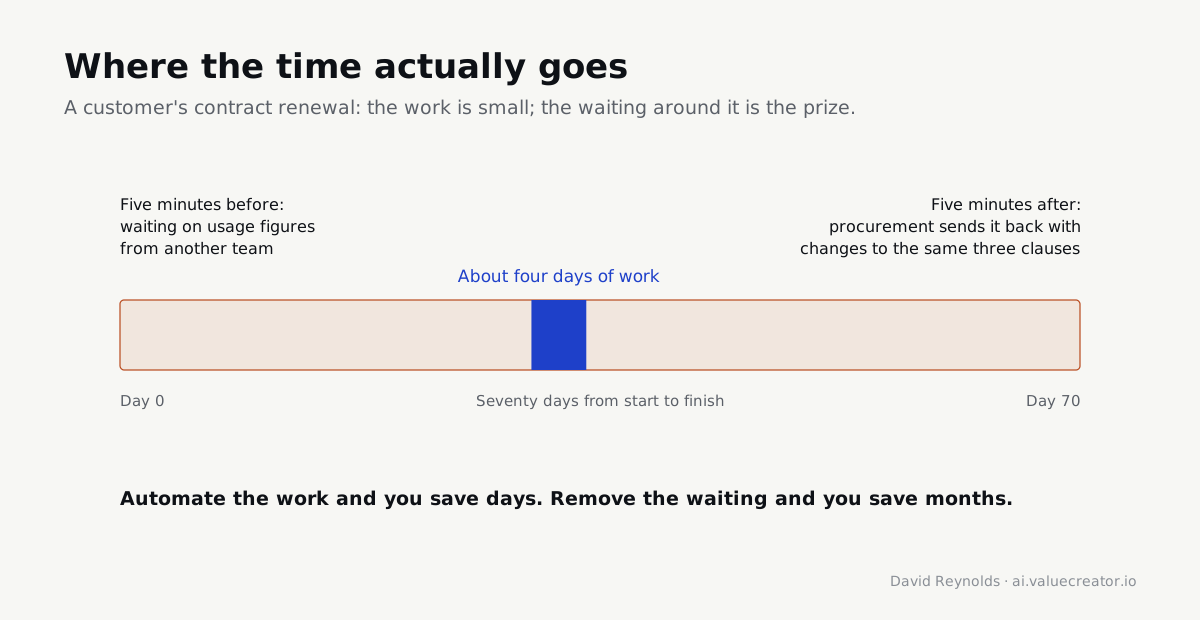
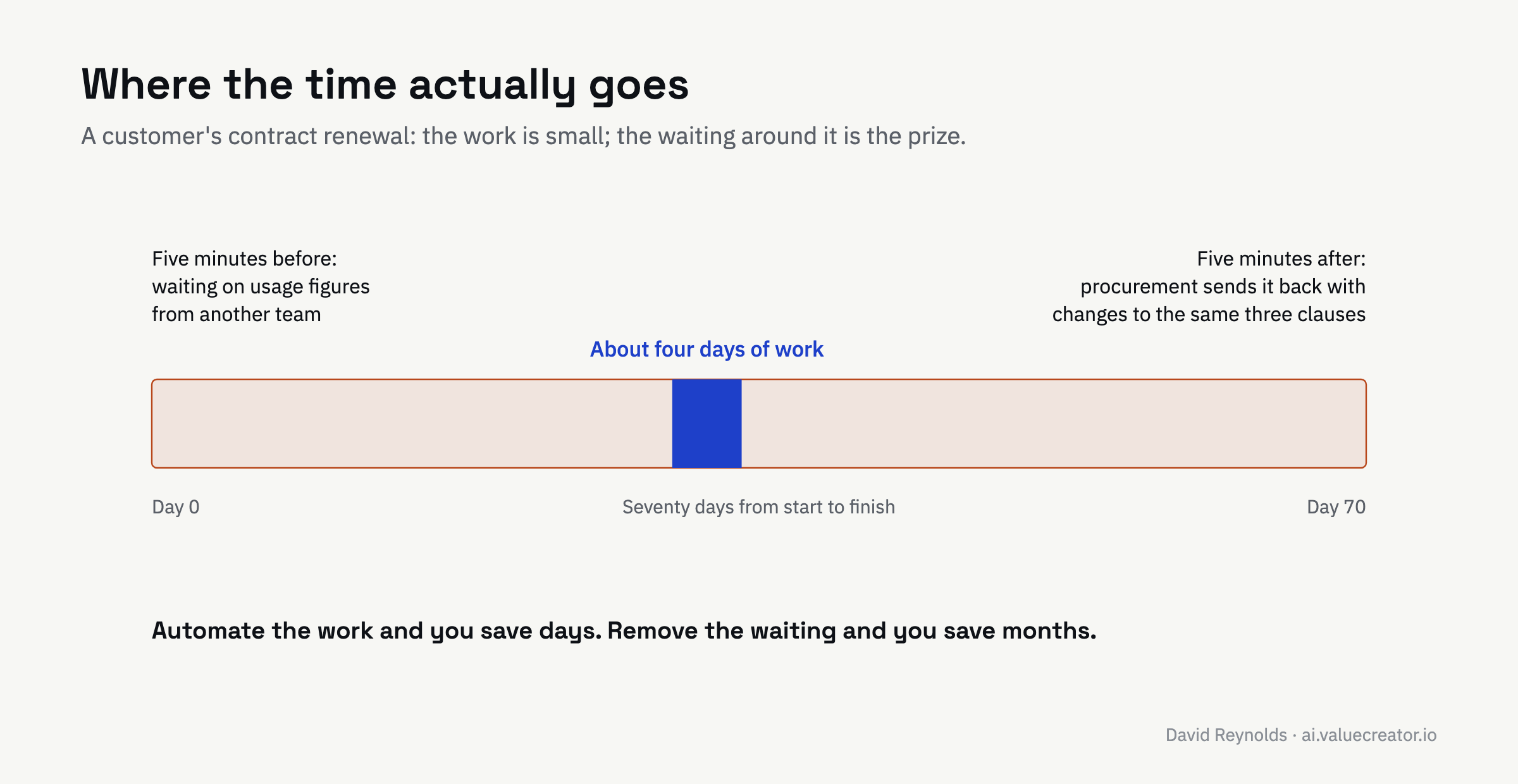
Take a customer's contract renewal that runs seventy days from start to finish, with only about four of them spent on the work. The rest is waiting on figures before and going round again after. Automating the work saves days; removing the waiting saves most of the seventy.

Where the time actually goesA customer's contract renewal: the work is small; the waiting around it is the prize.About four days of workDay 0Day 70Seventy days from start to finishFive minutes before:waiting on usage figuresfrom another teamFive minutes after:procurement sends it back withchanges to the same three clausesAutomate the work and you save days. Remove the waiting and you save months.David Reynolds · ai.valuecreator.io
Five minutes before:waiting on usage figuresfrom another teamAbout four days of workDay 0Day 70Seventy daysFive minutes after:procurement sends it back withchanges to the same three clausesAutomate the work and you save days.Remove the waiting and you save months.

Download SVGDownload PNGLink to this picture

Go or stop, one stage at a time

From Where the time actually goes

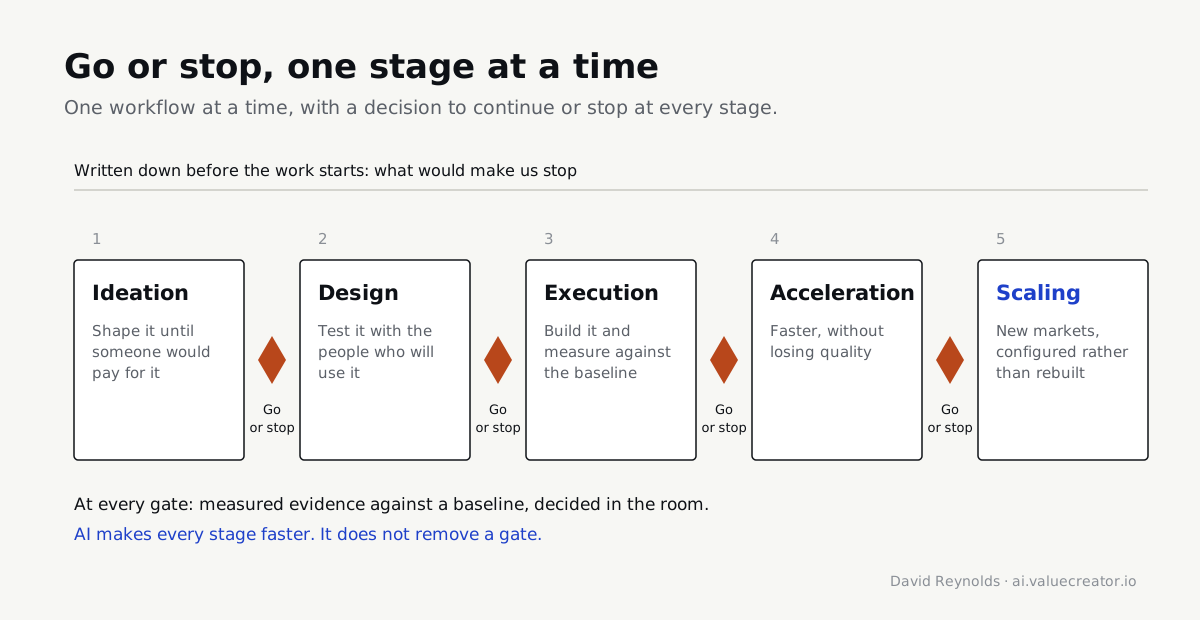
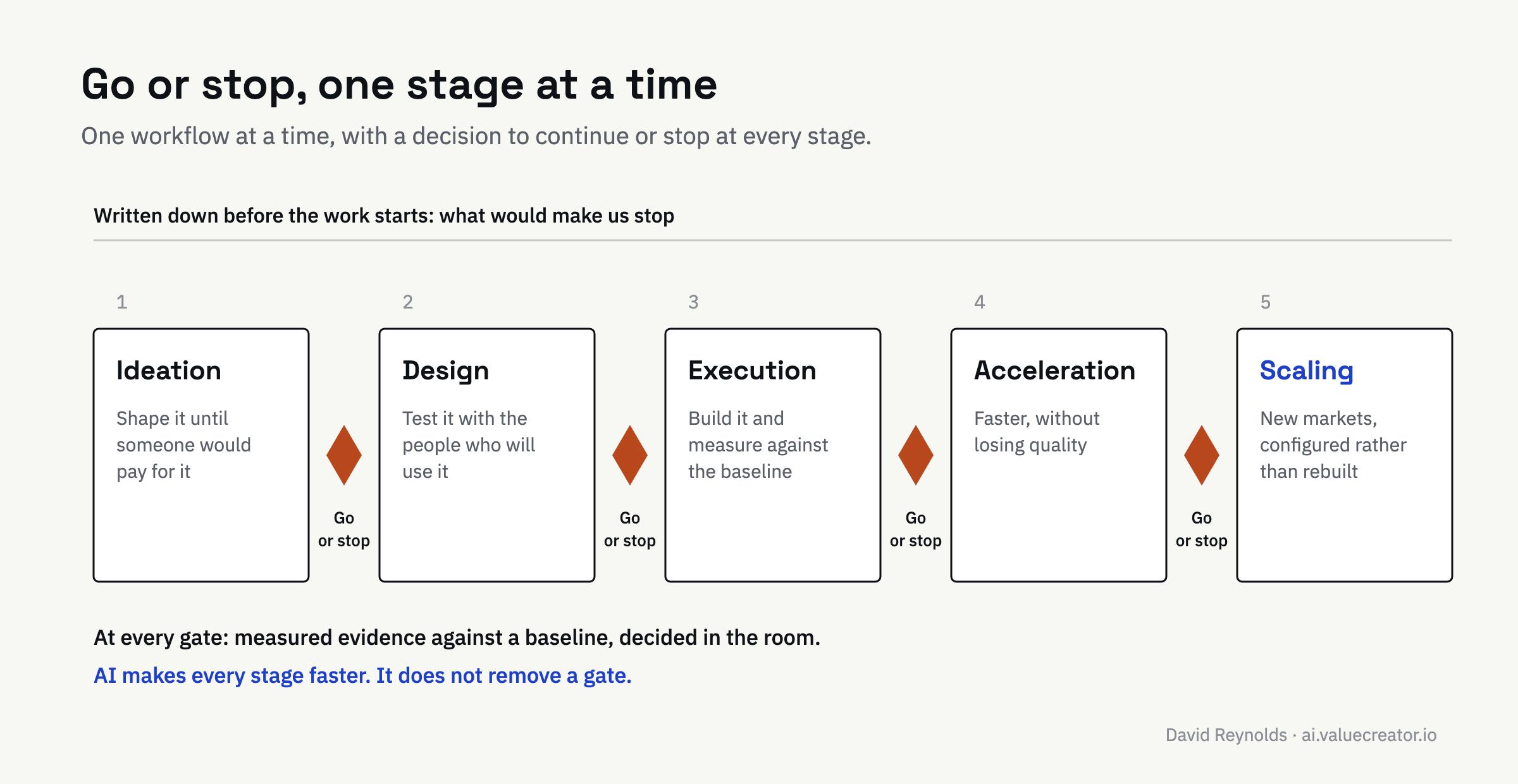
One workflow at a time, through five stages, with a decision to carry on or stop between each, taken on measured evidence against criteria written down first. AI makes every stage faster. It doesn't remove a gate.
Go or stop, one stage at a timeOne workflow at a time, with a decision to continue or stop at every stage.IdeationShape it untilsomeone wouldpay for it1Goor stopDesignTest it with thepeople who willuse it2Goor stopExecutionBuild it andmeasure againstthe baseline3Goor stopAccelerationFaster, withoutlosing quality4Goor stopScalingNew markets,configured ratherthan rebuilt5Written down before the work starts: what would make us stopAt every gate: measured evidence against a baseline, decided in the room.AI makes every stage faster. It does not remove a gate.David Reynolds · ai.valuecreator.io
Written down before the work starts:what would make us stop1IdeationShape it until someone would pay for itGo or stop2DesignTest it with the people who will use itGo or stop3ExecutionBuild it and measure against the baselineGo or stop4AccelerationFaster, without losing qualityGo or stop5ScalingNew markets, configured not rebuiltAt every gate: measured evidence against abaseline, decided in the room.AI makes every stage faster.It doesn't remove a gate.

Download SVGDownload PNGLink to this picture

The pictures · AI, and what a business is worth